From Observation to Abstraction: Inside My Art Practice
“By its very nature every embodied spirit is doomed to suffer and enjoy in solitude.
Sensations, feelings, insights, fancies - all these are private and, except through symbols and at second hand, incommunicable.”
Aldous Huxley, The Doors of Perception
An interior drawing or a word written across a canvas might seem like very different beginnings. In my studio, both can become landscapes. Here I share my abstract painting process, from observational drawings and handmade sketchbooks to layered surfaces and paintings that begin with words.
Drawing of an interior, a city street, a landscape, a word - is a starting point and its something I enjoy as my regular practice . I draw people only in life drawing classes, and I never start with a clear image in mind. Instead, I begin by observing, mark making, or assembling collage in the studio.
From there, I can draw the same subject once or several times. I may vary the scale, materials, colours or the relationship between shapes. Sometimes the subject remains identifiable; other times it vanishes almost entirely. I love to observe how the same scene can become so different in mood and atmosphere.
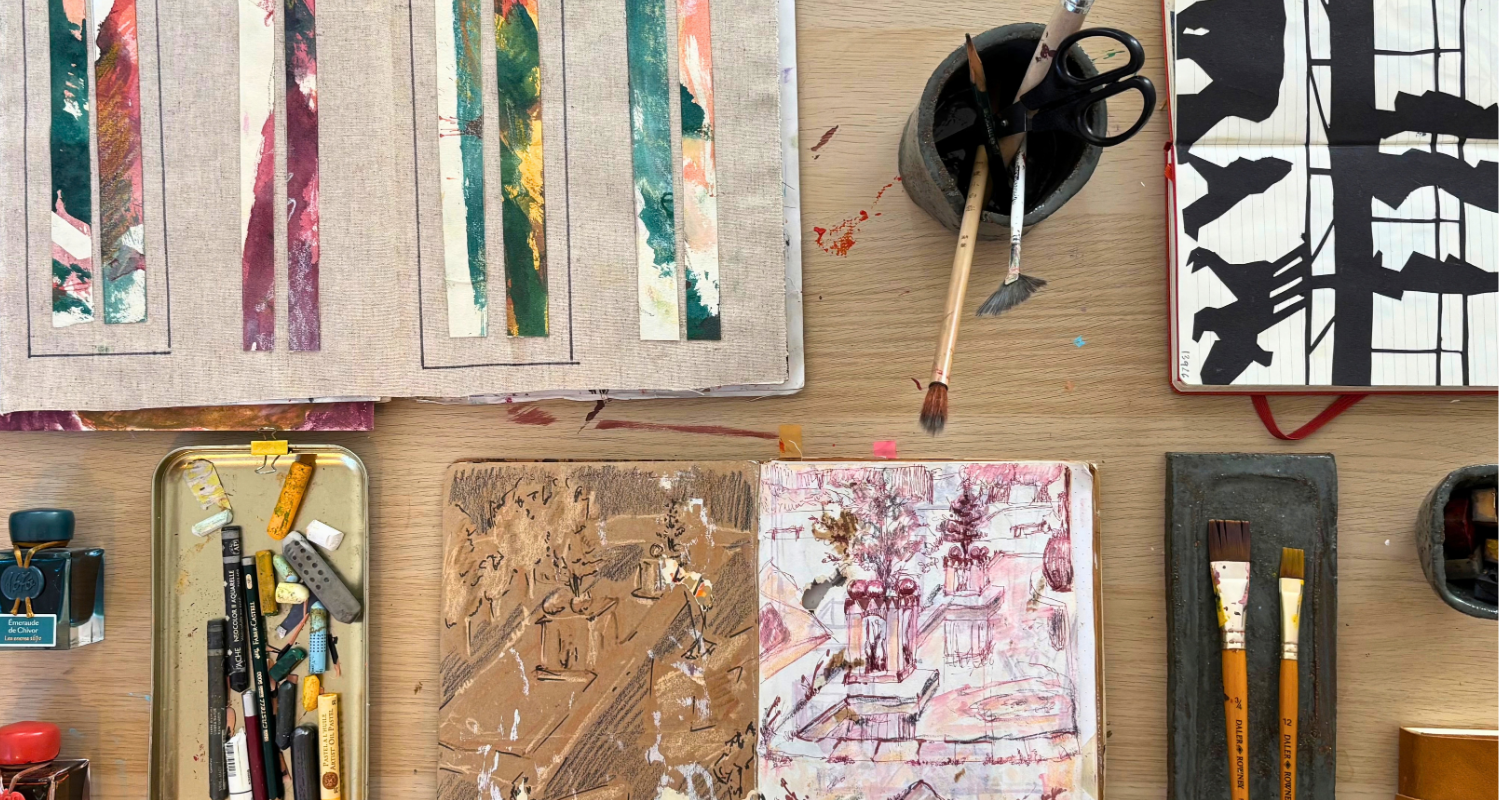
Art studio sketchbooks
Handmade Sketchbooks: Paper, Texture and Collage
I have been making and altering them since I was a teenager; the first one I made at sixteen is still with me. I glue in papers with different colours and textures, add fragments, and sometimes paint over pages I do not like. The book becomes a surface with a history before the next drawing begins.
That matters because I don't want every page to begin as the same white rectangle. Coloured paper, a torn edge, or an old mark changes the first decision. Sometimes the page tells me what kind of drawing it wants before I know what I am going to put on it.
I love to make my own tools for drawing and mark making. Often I alter brushes and use natural materials like twigs to make interesting mark-making tool. I am interested in discovering new brushstrokes and expressive mark-making.
Building Textured Abstract Painting Surfaces with Canvas, Collage and Wax
The same thinking continues on a larger scale. Constructing the surface itself is very important part of the process: cutting and collaging pieces of canvas, cardboard, or paper; layering material; changing texture; or asking whether something unexpected, even rope, can become part of the surface.
Recently I have been working with collage and oil paint mixed with wax medium because I love grainy, thick, expressive marks and the physical possibilities they create when mixed with oil sticks.
Sometime i prep different surfaces and leave them on a side for a while. I love having all those surfaces around the studio, i look at them and ask - what the work is asking for next?' - this process is essential part of my inspiration.
Research, play and experimentation are at the core of my studio routines. There is never a plan and i never enlarge my sketches so i keep the sense of wonder, curiosity and discovery.
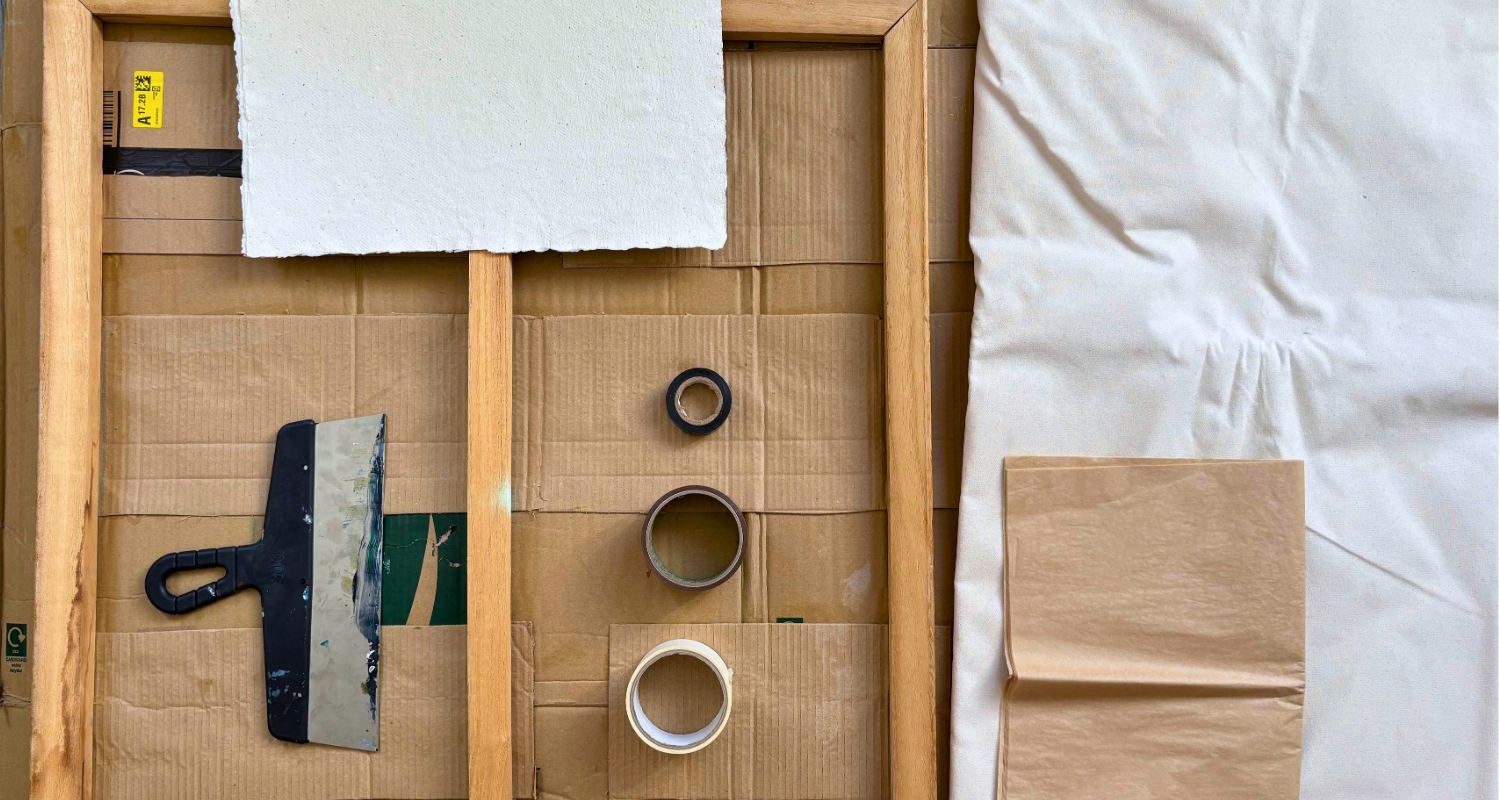
Materials for surface construction
When Words Become Shapes: Letterforms in Abstract Painting
Phrases and words is one of the starting point for abstraction. I use this approach in my recent project Microcosm: In Play, where words and letterforms move through a process of layering and abstracting colour and form.
The words first entered the paintings as words of care. I wrote them in transparent acrylic, one over another, until the surface became saturated, colourful, and increasingly difficult to read. At some point the word and letters began to split into curves, blocks, pathways, and fragments creating its own landscape or perhaps a feeling of a word.
I am mesmerised by turning words into almost topography maps or landscapes, leaving some elements readable. An unreadable word curiously tickles my brain because I feel that I should know it. Its not about inventing your own language, rather a sense of play with words. Making up new words or even a sense of learning a meaning of words. Its about association and interpretation.
Mother Tongue, Memory and Play in My Abstract Art
Behind the letterforms is a larger question that I am still working through: the idea of mother tongue as a sense of home. I am interested in how the first language we learn shapes perception, memory, and the way we organise experience, but I don't have a neat conclusion about it yet.
For me, it is also connected to childhood play. Before play becomes self-conscious, language can be flexible: children invent words, rules, sounds, and whole systems, then change them without needing permission. I am curious about whether a sense of language can survive visually after the literal word becomes unreadable.
Words, like objects in my observational drawings, can lose their familiar form and become sensations and atmospheres.
This uncertainty is important. I do not want to force the work into a finished thesis about language or identity. I am painting to find out what the question is.
From Sketchbook to Abstract Painting: Microcosm: In Play
The sketchbook is not a set of instructions for the large paintings. I use it to test combinations, repeat shapes, push colour relationships, and notice forms that I want to return to. A page can feed a painting without becoming its blueprint.
When a form moves onto a larger surface, scale changes the gesture. A small curve made from the wrist can become a movement of the whole arm. Colour occupies more physical space. Shapes that felt balanced in a book may need to be separated, enlarged, covered, or rebuilt. The painting begins to make its own demands.
I find it boring to enlarge an idea I already solved in the sketchbook. I want discovery to continue at full scale. The pleasure and the value for me is in discovering the process. Process then develops the idea.
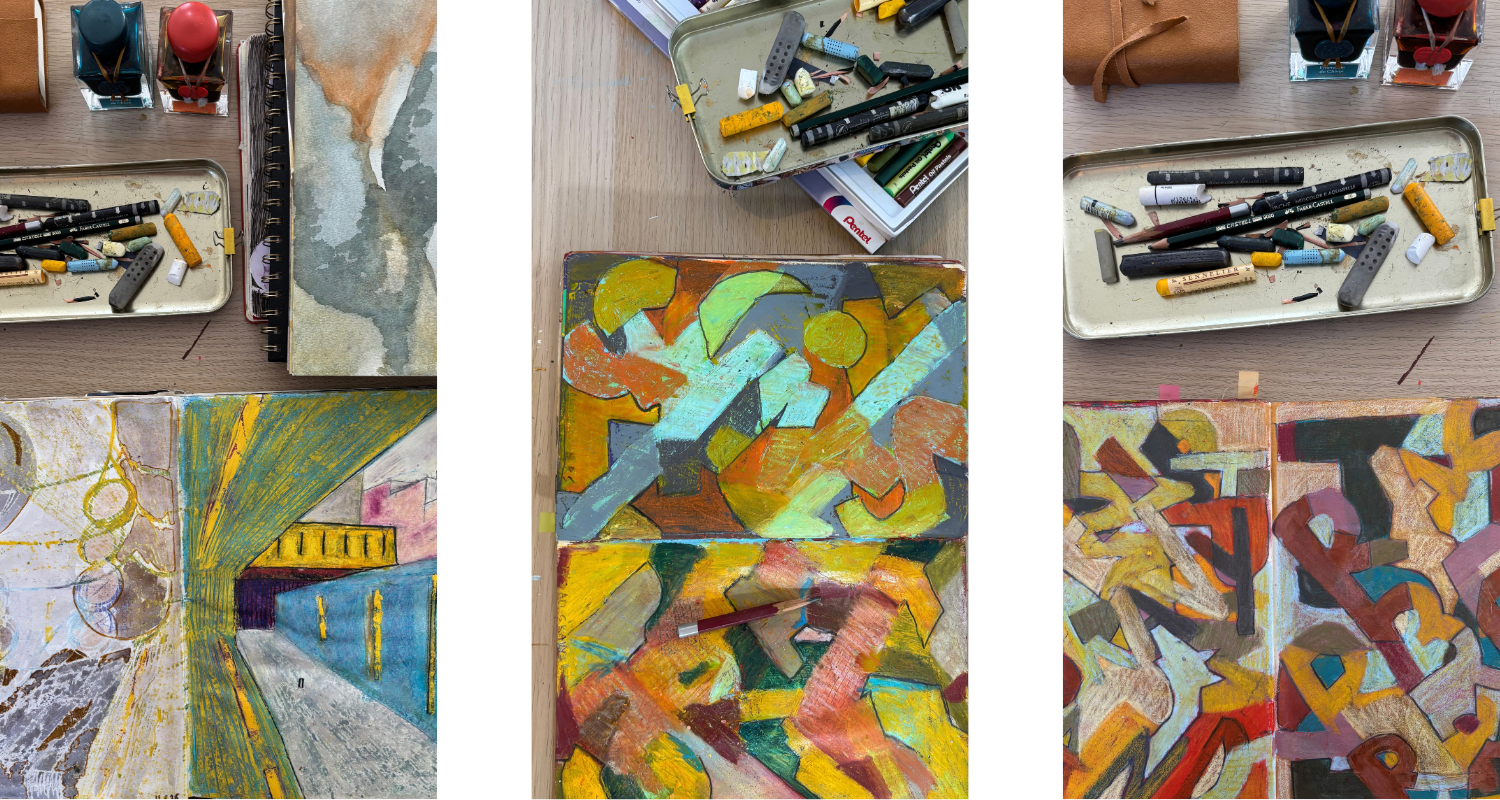
Artist sketchbook pages
Observational Drawing: Finding Forms in Interiors and Landscapes
Another starting point is real-life observations, I notice the overall space and then search for interesting forms and shapes instead of listing particular objects. At a single location, I can usually discover five or six different compositions by altering the frame. The kind of drawing I produce from a given scene can be entirely different depending on the elements I decide to include.
I have a great affection for interiors, especially intimate ones where people carry out their daily lives. While I am concerned with the space surrounding a person, I am also interested in the concept of an interior existing within the body or the mind. In the same way, a natural landscape can begin to resemble an inner or emotional landscape, and urban structures can reflect something more psychological through their geometry, density, or rhythm.
Everything in the city is made by people for people: it reflects how we think and what we think we need.
Through direct observation, I've learned that a drawing is never neutral. Changing the crop, using a darker area, altering the balance of light and shade, or simplifying one shape can entirely change its effect. Negative space is a shape, just as the space between objects can be as important as the objects themselves.
Accuracy isn't my primary aim; I value expression and the line's liveliness more. Plein-air drawing is usually uncomfortable and difficult, and I enjoy it precisely because of that. The surroundings change, people move, the weather affects things, and I have to make quick decisions. I feel more present in the place than when I work from a fixed reference.
Drawing from Drawings: From Observation to Abstraction
A drawing done from life is usually only the first attempt; in the studio, I draw based on that drawing and explore different ways to express the same thing.
When I am redrawing, I consider what improvements I want to make and what aspects I want to experiment with.
I could alter the paper format, reverse the relationship between light and dark, move from colour to black and white, or use a material that produces a different kind of mark. I might redraw an image once or twelve times. There is no set number, and I will keep going so long as the subject continues to interest and amuse me.
It is instinctive and intuitive, yet there is a structure beneath it. I am not aiming to produce a cleaner version; each version presents me with a different problem and a different possibility.
Landscape, Collage and Visual Memory in Abstract Drawing
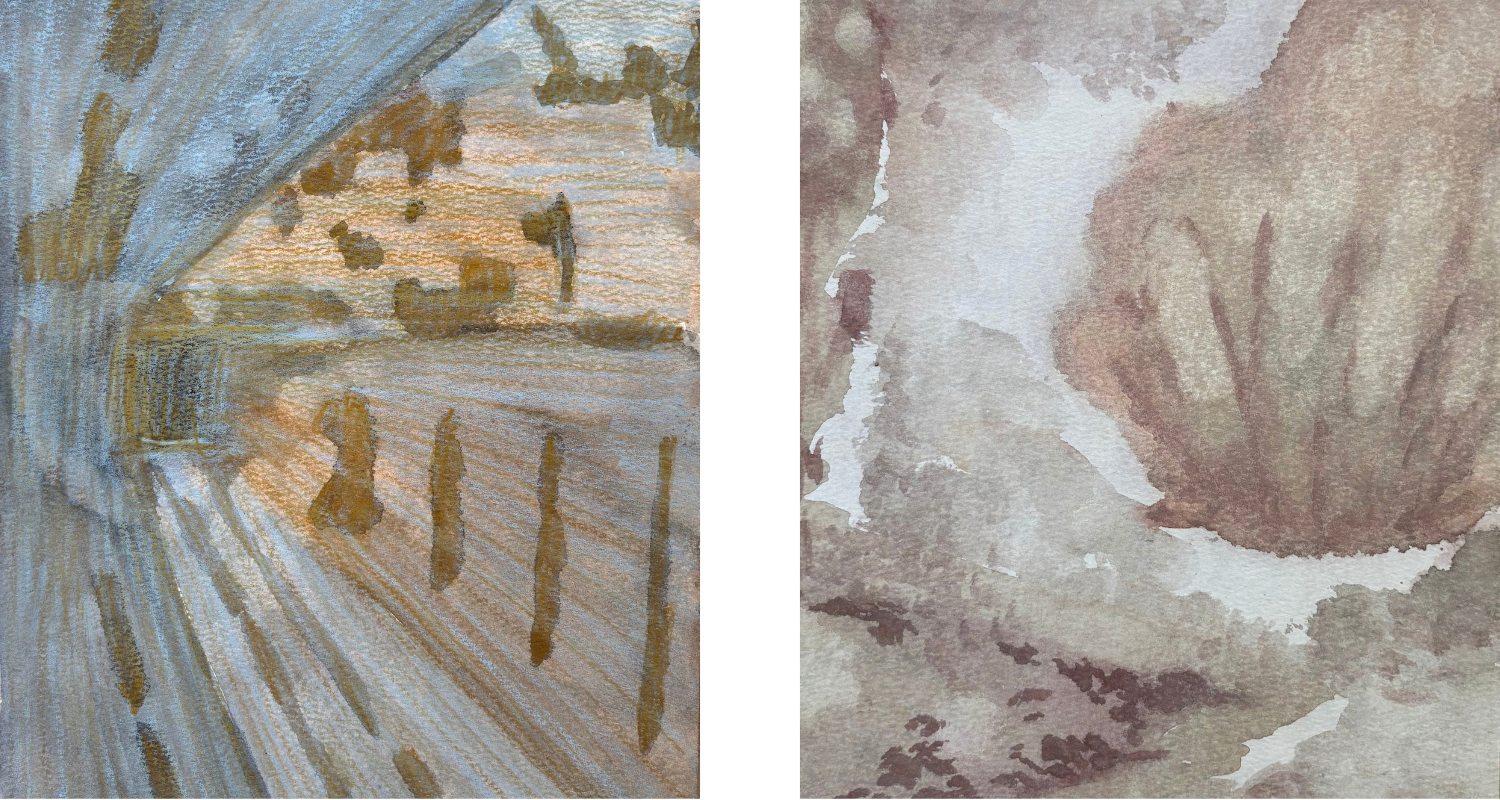
The more times a subject is redrawn, the more abstract the composition becomes.
One exercise I enjoy takes that principle even further. Before I know what the final result will be, I stick random pieces from a collage into my sketchbook and later try to fit a landscape into them. The drawing has to work with the elements already present, which makes it more intriguing.
Artist studio moments
Looking at Abstract Art: Curiosity, Wonder and Play
I want the work to create curiosity, wonder, and play. It does not need to be overly serious. There should be enough space for somebody else’s associations to enter it.
For me, that's why I keep returning to observation and making. The world already contains more forms and relationships than I could invent deliberately. Drawing lets me notice them. Redrawing lets me add something of my own. Somewhere between structure and instinct, the work begins to become its own thing.
I am not trying to arrive at abstraction as a destination. I am interested in what happens during the transformation.